 Mivo
Habit tracker ideas for 2027 (with a free printable)
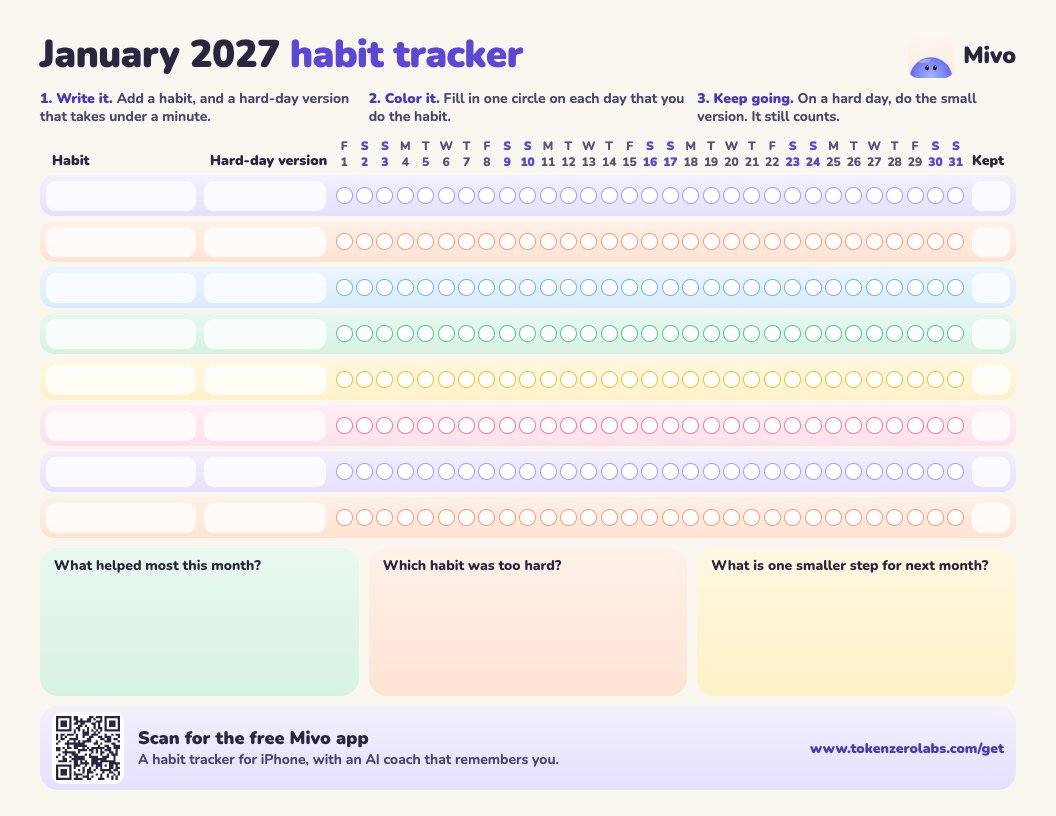
Short answer: Pick three to five habits, not fifteen. Give each one a small version for hard days, such as "put on your walking shoes" for "walk 30 minutes". Mark each day that you do it, and review the page at the end of the month. You can print our free 2027 habit tracker to start.
Habit ideas by goal
Each idea has a small version for hard days. On a hard day, do the small version. It still counts.

Health and movement
- Walk for 30 minutesHard day Put on your shoes and go outside
- Drink a glass of water with breakfastHard day One sip
- Stretch for 10 minutesHard day One stretch
- Eat a vegetable with lunchHard day One bite
- Take the stairsHard day One floor

Sleep
- Go to bed at the same timeHard day Get into bed, even if you read
- No screens in the last 30 minutes before bedHard day Put the phone on the charger
- Get daylight in the morningHard day Open the curtains

Mind
- Read 10 pagesHard day Read one page
- Write three lines in a journalHard day Write one line
- Sit quietly for 5 minutesHard day Take three slow breaths
- Practice a language for 10 minutesHard day Learn one word

Work and study
- Plan tomorrow before you finish workHard day Write the first task
- Do 25 minutes of focused work before emailHard day Open the document
- Review your notesHard day Read one page of notes

Home and money
- Clear the kitchen before bedHard day Put one dish away
- Write down what you spent todayHard day Write one amount
- Tidy one area for 10 minutesHard day Tidy one surface

People
- Message a friend or family memberHard day Send one line
- Eat one meal without your phoneHard day Put the phone in another room
- Say thank you to someoneHard day One thank you
How to choose your habits
Start with fewer habits than you want. Three habits that you keep teach you more than ten that you drop in a week. You can add more when the first ones feel easy. Our printable has room for eight, and most people do not need all eight in January.
Choose habits that you want. A 2024 review of habit research found that habits people chose themselves tended to be stronger. A habit from someone else's list is fine only if you want it too.
Pick habits that can happen on most days. A daily or near-daily habit gives you more chances to repeat it. If a habit happens once a week, such as a long run, a monthly grid will look mostly empty.
Tie each habit to something that you already do. Write "after breakfast, drink a glass of water" and not only "drink water". A 2015 study found that cues tied to an event helped a behavior become automatic. Reminders helped people repeat it, but they did less for the automatic part.
Tracker layout ideas
Monthly grid
Habits go down the side, days 1 to 31 go across the top, and you fill in one circle each day. This is the layout in our free printable. It shows which days you usually skip.
Small-version column
Next to each habit, write its small version. You decide what counts on a hard day before the hard day arrives.
Kept count and review
At the end of each row, count the days that you kept the habit. Then answer a few questions: What worked? Which day was hardest? What will I change next month?
Weekly view
If a month feels too long, use one row of seven boxes for each habit. It suits habits that do not happen every day, and each week is a fresh start.
A 2016 analysis of goal research found that progress monitoring worked better when people physically recorded it. Paper is one simple way to do that.
What to do when you miss a day
Return at your next chance. In a 2010 study of habit formation, missing one opportunity did not materially affect the habit. On the day after a miss, do at least the small version so that one skip does not become two.
Leave the circle empty and keep going. An honest record is more useful than a perfect one. Our guide on how long it takes to form a habit explains what the research found about missed days.
Paper or app?
Paper works well. It is free, it has no notifications to ignore, and you can see the whole month on one page. If you like to write things down, start with paper.
An app works well if your phone is always with you. It can remind you and add up your patterns for you. Our guide to habit tracker apps compares several.
We make Mivo, an iPhone habit tracker with a coach. You tell it what you did in plain words, and it logs the habit. It remembers the context that you share, such as a busy week. For a hard habit, tiny mode helps you make the habit smaller. We have not studied whether Mivo helps people form habits faster.
Habits to stop
A habit that you want to stop is harder to track, because the goal is to do nothing. Three ideas help:
- Track the replacement. Do not write "no phone in bed". Write "phone charges in the kitchen", and mark the days that you do it.
- Track the setting, not the urge. Write "no snacks on my desk" and not "stop snacking". A change to your setting is easier to check each day.
- Count the good days. Fill in a circle for each day without the old habit. Do not mark the days that you slip.
Ideas to try:
- Instead of: Scrolling in bedTrack: Phone charges outside the bedroom
- Instead of: Late coffeeTrack: Coffee only before noon
- Instead of: Checking the phone during workTrack: Notifications off during focused work
- Instead of: Snacking out of boredomTrack: A glass of water before a snack
- Instead of: Social media on the phoneTrack: Social media only on a computer
Your first week in January
- PrintPrint the free 2027 tracker, or set up your app.
- ChooseChoose three habits.
- ShrinkWrite a small version for each one.
- AnchorWrite the event that each habit follows, such as "after breakfast".
- MarkMark the page on the same day that you do the habit.
- ReviewOn day 7, look at the page and change one thing.
Sources
- Singh and colleagues (2024). Time to form a habit: a systematic review and meta-analysis. Healthcare. We read the full text.
- Stawarz, Cox, and Blandford (2015). Beyond self-tracking and reminders: designing smartphone apps that support habit formation. CHI Conference proceedings. We read a summary of the abstract on the publisher's research page, and we did not read the full paper.
- Harkin and colleagues (2016). Does monitoring goal progress promote goal attainment? A meta-analysis of the experimental evidence. Psychological Bulletin. We read the accepted manuscript.
- Lally, van Jaarsveld, Potts, and Wardle (2010). How are habits formed: Modelling habit formation in the real world. European Journal of Social Psychology. We read the abstract.
This post is general information, not medical or psychological advice.